Two Distinct Electorates
Lliberal Dems that the special presidential electorate has anointed since Nixon did not reflect the political proclivities of the American people – especially since 1994. Their kind can be defeated – as Reagan did

Ron Lipsman , Bio and Archives--February 25, 2015
American Politics, News | Comments | Reader Friendly | Subscribe | Email Us
Interest in the 2016 presidential election contest is heating up. It is an arguably unfortunate aspect of the US national political scene that no more than midway through a presidential term, the nation might be paying as much attention to whom the next occupant of the White House may be than to the current resident.
But so be it; here I add to the perhaps misbegotten attention with a thesis that the electorate which will make that choice is quite different from the body of voters who cast their ballots in virtually any non-presidential election. In order to justify that assertion, I am going to hit you with a cascade of past election data, out of which an unmistakable conclusion unfolds. First, let us consider the "closeness" of past presidential elections. In fact, one can easily characterize all presidential elections into one of three categories: a blowout or landslide victory; a squeaker in which a proportionally tiny change in the ballots cast could have changed the outcome; and a comfortable victory – a clear margin in both the electoral and popular votes, but short of an overwhelmingly one-sided outcome. Since the end of WWII, here is how the presidential elections stack up:
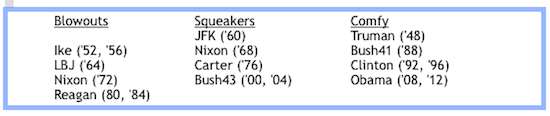 Here are a few important points to note. Five of the six blowouts have been enjoyed by Republicans. The squeakers were evenly divided between the parties. And finally, the comfortable or moderate size victories were gained primarily by Democrats. An interpretation will follow below.
Now consider the composition of the US Congress and Senate. There is of course a natural amount of see-saw over the years, but certain trends are unmistakable. After the dominance by the Democrats during the Roosevelt era, in the years following WWII (1945-1960), control of the House and Senate was fairly evenly divided between the parties. But between 1960 and 1994, the Democrat dominance of the Congress and Senate was stark – often with 2-1 majorities in the Senate and 100-seat or more differences in the House. This changed dramatically in 1994; and that change has perpetuated itself in the ensuing 20 years. While control of the Senate has oscillated, the GOP – with the exception of four years – has controlled the House, often by substantial majorities. In order to match the recent prolonged GOP dominance, one must go back nearly a century. Moreover, the nature of the GOP caucus is much more conservative than at any time over that century.
Next, we consider statewide dominance by party. We shall use two measures – which party controlled the governor's mansion, and in how many states did one party control both houses of the state legislature? In these regards, the data reinforces what we have seen for the Congress and Senate; in fact, it is even more striking. From the mid-50s through 1994, the Dems overwhelmingly controlled the state legislative houses in a majority of the states (often as many as two-thirds of the states) and usually by a margin of three-to-one. This changed dramatically in 1994 and, with few exceptions, the years since then have seen the GOP in control of both state legislative houses in three fifths of the states; which Democrats do likewise in no more than 30% of the nation.
We see the same pattern in the governor's mansions. With few exceptions, the Dems controlled more governorships than the GOP from the end of WWII through 1994. Since then, again with very few exceptions, the roles have reversed.
What are we to make of all this information? I maintain that it strongly suggests the following. In the last twenty years, there has been a dramatic and unquestionable shift in the overall US electorate to the right. At all levels – except for the presidential – the composition of the body of elected federal and state officials has shifted dramatically away from Democrats and toward Republicans. Now the composition of the parties has also changed drastically in the last thirty or so years. Traditionally, there was a conservative wing of the Democrat Party (primarily, but not exclusively, in the south). Blue Dogs they were called. They no longer exist. Your average elected Democrat Party official today is overwhelmingly likely to be liberal, and in more cases than not, strikingly so. The center of gravity of the Democrat Party has shifted, incredibly, far to the left and, if the events of the Obama era are indicative, that center of gravity continues to drift left.
Secondly, the GOP once had a rather liberal wing (primarily, but not exclusively, in the northeast). In fact, the liberal/moderate wing of the party was more than a significant component of the Republican Party – for decades, it controlled the party. The "house-cleaning" of the GOP has not been anywhere near as complete as in the Democrat Party; and the GOP has not shifted to the right nearly as much as the Dems have migrated left. But there is no question that the average GOP elected official today is more conservative than at any time in the last 85 years.
Moreover, the info already cited suggests that the same is true of the American electorate. The dramatically increased GOP proportion of statewide or locally elected federal and state officials demonstrates it conclusively. So how is it possible that the Dems have won the presidency in four of the last six presidential elections; and in the other two, they actually won the popular vote in one and narrowly lost it in the other?
The answer is that the composition of the electorate is drastically different in a presidential election than it is in any other national or statewide election. This is the only sensible explanation. In fact, the nature of that difference is rather evident upon examination:
Here are a few important points to note. Five of the six blowouts have been enjoyed by Republicans. The squeakers were evenly divided between the parties. And finally, the comfortable or moderate size victories were gained primarily by Democrats. An interpretation will follow below.
Now consider the composition of the US Congress and Senate. There is of course a natural amount of see-saw over the years, but certain trends are unmistakable. After the dominance by the Democrats during the Roosevelt era, in the years following WWII (1945-1960), control of the House and Senate was fairly evenly divided between the parties. But between 1960 and 1994, the Democrat dominance of the Congress and Senate was stark – often with 2-1 majorities in the Senate and 100-seat or more differences in the House. This changed dramatically in 1994; and that change has perpetuated itself in the ensuing 20 years. While control of the Senate has oscillated, the GOP – with the exception of four years – has controlled the House, often by substantial majorities. In order to match the recent prolonged GOP dominance, one must go back nearly a century. Moreover, the nature of the GOP caucus is much more conservative than at any time over that century.
Next, we consider statewide dominance by party. We shall use two measures – which party controlled the governor's mansion, and in how many states did one party control both houses of the state legislature? In these regards, the data reinforces what we have seen for the Congress and Senate; in fact, it is even more striking. From the mid-50s through 1994, the Dems overwhelmingly controlled the state legislative houses in a majority of the states (often as many as two-thirds of the states) and usually by a margin of three-to-one. This changed dramatically in 1994 and, with few exceptions, the years since then have seen the GOP in control of both state legislative houses in three fifths of the states; which Democrats do likewise in no more than 30% of the nation.
We see the same pattern in the governor's mansions. With few exceptions, the Dems controlled more governorships than the GOP from the end of WWII through 1994. Since then, again with very few exceptions, the roles have reversed.
What are we to make of all this information? I maintain that it strongly suggests the following. In the last twenty years, there has been a dramatic and unquestionable shift in the overall US electorate to the right. At all levels – except for the presidential – the composition of the body of elected federal and state officials has shifted dramatically away from Democrats and toward Republicans. Now the composition of the parties has also changed drastically in the last thirty or so years. Traditionally, there was a conservative wing of the Democrat Party (primarily, but not exclusively, in the south). Blue Dogs they were called. They no longer exist. Your average elected Democrat Party official today is overwhelmingly likely to be liberal, and in more cases than not, strikingly so. The center of gravity of the Democrat Party has shifted, incredibly, far to the left and, if the events of the Obama era are indicative, that center of gravity continues to drift left.
Secondly, the GOP once had a rather liberal wing (primarily, but not exclusively, in the northeast). In fact, the liberal/moderate wing of the party was more than a significant component of the Republican Party – for decades, it controlled the party. The "house-cleaning" of the GOP has not been anywhere near as complete as in the Democrat Party; and the GOP has not shifted to the right nearly as much as the Dems have migrated left. But there is no question that the average GOP elected official today is more conservative than at any time in the last 85 years.
Moreover, the info already cited suggests that the same is true of the American electorate. The dramatically increased GOP proportion of statewide or locally elected federal and state officials demonstrates it conclusively. So how is it possible that the Dems have won the presidency in four of the last six presidential elections; and in the other two, they actually won the popular vote in one and narrowly lost it in the other?
The answer is that the composition of the electorate is drastically different in a presidential election than it is in any other national or statewide election. This is the only sensible explanation. In fact, the nature of that difference is rather evident upon examination:
- The percentage of the electorate that votes in presidential elections is significantly higher than it is in other elections. Who are these extra voters?
- The apathy of the American electorate at election time is well-known; in recent decades, roughly 55% turn out to vote for president. But the participation rate in non-presidential elections is more like 35%. Again, which voters do we find in the missing 20%?
- Rightly or wrongly, voters attach greater significance to presidential elections than to congressional or state elections. They see the outcome of their choice as more influential in their lives, their jobs, and their family; more significant for the country, indeed for the world.
- Perhaps more importantly, the hoopla attending a presidential election dwarfs that for a senator or governor. The people want to be part of the action. They respond to the increased exhortations to participate. But the question remains: is there any pattern to the group that responds?
- I believe the answer is: those who are titillated by the hoopla, those who expect the outcome to have a major impact on their lives; those who do not ordinarily take seriously their civic duty to vote are not simply the low information voters (as conservatives are wont to call them), but more comprehensively, young people, those in the lower socio-economic classes and of course minorities. Exactly the key components of the liberal coalition.
- One could argue that the elderly should be included in the list. But generally, the elderly vote in great numbers in all elections; their voter participation rate doesn't change much for presidential elections.
- Fine tune his message in order to attract some of the additional voters who turn out for presidential elections;
- But without compromising his principles! Reagan showed that it can be done. A strong conservative who articulates well and clearly how conservative policies will help all segments of American society to prosper and be free can overcome the inherently biased, increased electorate by (i) converting some of the occasional voters to his side; and (ii) attracting other non-voters who might be susceptible to the conservative message.
View Comments
Ron Lipsman——Bio and Archives
Ron Lipsman, Professor Emeritus of Mathematics at the University of Maryland, writes about politics, culture, education, science and sports at Ronlipsman.com. Follow him on Twitter @rlipsman