Carbon Currency: A New Beginning for Technocracy?
Global currency replacing all paper currencies, limiting manufacturing, food production and people movement

Guest Column Patrick Wood, Bio and Archives--January 26, 2010
Cover Story | Comments | Reader Friendly | Subscribe | Email Us
 Introduction
Critics who think that the U.S. dollar will be replaced by some new global currency are perhaps thinking too small.
On the world horizon looms a new global currency that could replace all paper currencies and the economic system upon which they are based.
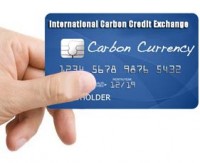
The new currency, simply called Carbon Currency, is designed to support a revolutionary new economic system based on energy (production, and consumption), instead of price. Our current price-based economic system and its related currencies that have supported capitalism, socialism, fascism and communism, is being herded to the slaughterhouse in order to make way for a new carbon-based world.
Introduction
Critics who think that the U.S. dollar will be replaced by some new global currency are perhaps thinking too small.
On the world horizon looms a new global currency that could replace all paper currencies and the economic system upon which they are based.
The new currency, simply called Carbon Currency, is designed to support a revolutionary new economic system based on energy (production, and consumption), instead of price. Our current price-based economic system and its related currencies that have supported capitalism, socialism, fascism and communism, is being herded to the slaughterhouse in order to make way for a new carbon-based world. It is plainly evident that the world is laboring under a dying system of price-based economics as evidenced by the rapid decline of paper currencies. The era of fiat (irredeemable paper currency) was introduced in 1971 when President Richard Nixon decoupled the U.S. dollar from gold. Because the dollar-turned-fiat was the world’s primary reserve asset, all other currencies eventually followed suit, leaving us today with a global sea of paper that is increasingly undesired, unstable, unusable. The deathly economic state of today’s world is a direct reflection of the sum of its sick and dying currencies, but this could soon change. Forces are already at work to position a new Carbon Currency as the ultimate solution to global calls for poverty reduction, population control, environmental control, global warming, energy allocation and blanket distribution of economic wealth. Unfortunately for individual people living in this new system, it will also require authoritarian and centralized control over all aspects of life, from cradle to grave. What is Carbon Currency and how does it work? In a nutshell, Carbon Currency will be based on the regular allocation of available energy to the people of the world. If not used within a period of time, the Currency will expire (like monthly minutes on your cell phone plan) so that the same people can receive a new allocation based on new energy production quotas for the next period. Because the energy supply chain is already dominated by the global elite, setting energy production quotas will limit the amount of Carbon Currency in circulation at any one time. It will also naturally limit manufacturing, food production and people movement. Local currencies could remain in play for a time, but they would eventually wither and be fully replaced by the Carbon Currency, much the same way that the Euro displaced individual European currencies over a period of time. Sounds very modern in concept, doesn’t it? In fact, these ideas date back to the 1930’s when hundreds of thousands of U.S. citizens were embracing a new political ideology called Technocracy and the promise it held for a better life. Even now-classic literature was heavily influenced by Technocracy: George Orwell’s 1984, H.G. Well’s The Shape of Things to Come and Huxley’s “scientific dictatorship” in Brave New World. This paper investigates the rebirth of Technocracy and its potential to recast the New World Order into something truly “new” and also totally unexpected by the vast majority of modern critics.
Background
Philosophically, Technocracy found it roots in the scientific autocracy of Henri de Saint-Simon (1760-1825) and in the positivism of Auguste Comte (1798- 1857), the father of the social sciences. Positivism elevated science and the scientific method above metaphysical revelation. Technocrats embraced positivism because they believed that social progress was possible only through science and technology. [Schunk, Learning Theories: An Educational Perspective, 5th, 315] The social movement of Technocracy, with its energy-based accounting system, can be traced back to the 1930’s when an obscure group of engineers and scientists offered it as a solution to the Great Depression.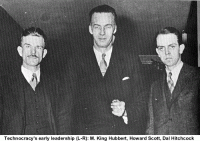 The principal scientist behind Technocracy was M. King Hubbert, a young geoscientist who would later (in 1948-1956) invent the now-famous Peak Oil Theory, also known as the Hubbert Peak Theory. Hubbert stated that the discovery of new energy reserves and their production would be outstripped by usage, thereby eventually causing economic and social havoc. Many modern followers of Peak Oil Theory believe that the 2007-2009 global recession was exacerbated in part by record oil prices that reflected validity of the theory.
Hubbert received all of his higher education at the University of Chicago, graduating with a PhD in 1937, and later taught geophysics at Columbia University. He was highly acclaimed throughout his career, receiving many honors such as the Rockefeller Public Service Award in 1977.
In 1933, Hubbert and Howard Scott formed an organization called Technocracy, Inc. Technocracy is derived from the Greek words “techne” meaning skill and “kratos”, meaning rule. Thus, it is government by skilled engineers, scientists and technicians as opposed to elected officials. It was opposed to all other forms of government, including communism, socialism and fascism, all of which function with a price-based economy.
As founders of the organization and political movement called Technocracy, Inc., Hubbert and Scott also co-authored Technocracy Study Course in 1934. This book serves as the “bible” of Technocracy and is the root document to which most all modern technocratic thinking can be traced.
Technocracy postulated that only scientists and engineers were capable of running a complex, technology-based society. Because technology, they reasoned, changed the social nature of societies, previous methods of government and economy were made obsolete. They disdained politicians and bureaucrats, who they viewed as incompetent. By utilizing the scientific method and scientific management techniques, Technocrats hoped to squeeze the massive inefficiencies out of running a society, thereby providing more benefits for all members of society while consuming less resources.
The other integral part of Technocracy was to implement an economic system based on energy allocation rather than price. They proposed to replace traditional money with Energy Credits.
Their keen focus on the efficient use of energy is likely the first hint of a sustained ecological/environmental movement in the United States. Technocracy Study Course stated, for instance,
The principal scientist behind Technocracy was M. King Hubbert, a young geoscientist who would later (in 1948-1956) invent the now-famous Peak Oil Theory, also known as the Hubbert Peak Theory. Hubbert stated that the discovery of new energy reserves and their production would be outstripped by usage, thereby eventually causing economic and social havoc. Many modern followers of Peak Oil Theory believe that the 2007-2009 global recession was exacerbated in part by record oil prices that reflected validity of the theory.
Hubbert received all of his higher education at the University of Chicago, graduating with a PhD in 1937, and later taught geophysics at Columbia University. He was highly acclaimed throughout his career, receiving many honors such as the Rockefeller Public Service Award in 1977.
In 1933, Hubbert and Howard Scott formed an organization called Technocracy, Inc. Technocracy is derived from the Greek words “techne” meaning skill and “kratos”, meaning rule. Thus, it is government by skilled engineers, scientists and technicians as opposed to elected officials. It was opposed to all other forms of government, including communism, socialism and fascism, all of which function with a price-based economy.
As founders of the organization and political movement called Technocracy, Inc., Hubbert and Scott also co-authored Technocracy Study Course in 1934. This book serves as the “bible” of Technocracy and is the root document to which most all modern technocratic thinking can be traced.
Technocracy postulated that only scientists and engineers were capable of running a complex, technology-based society. Because technology, they reasoned, changed the social nature of societies, previous methods of government and economy were made obsolete. They disdained politicians and bureaucrats, who they viewed as incompetent. By utilizing the scientific method and scientific management techniques, Technocrats hoped to squeeze the massive inefficiencies out of running a society, thereby providing more benefits for all members of society while consuming less resources.
The other integral part of Technocracy was to implement an economic system based on energy allocation rather than price. They proposed to replace traditional money with Energy Credits.
Their keen focus on the efficient use of energy is likely the first hint of a sustained ecological/environmental movement in the United States. Technocracy Study Course stated, for instance, Although it (the earth) is not an isolated system the changes in the configuration of matter on the earth, such as the erosion of soil, the making of mountains, the burning of coal and oil, and the mining of metals are all typical and characteristic examples of irreversible processes, involving in each case an increase of entropy. (Technocracy Study Course, Hubbert & Scott, p. 49)Modern emphasis on curtailing carbon fuel consumption that causes global warming and CO2 emissions is essentially a product of early Technocratic thinking. As scientists, Hubbert and Scott tried to explain (or justify) their arguments in terms of physics and the law of thermodynamics, which is the study of energy conversion between heat and mechanical work. Entropy is a concept within thermodynamics that represents the amount of energy in a system that is no longer available for doing mechanical work. Entropy thus increases as matter and energy in the system degrade toward the ultimate state of inert uniformity. In layman’s terms, entropy means once you use it, you lose it for good. Furthermore, the end state of entropy is “inert uniformity” where nothing takes place. Thus, if man uses up all the available energy and/or destroys the ecology, it cannot be repeated or restored ever again. The Technocrat’s avoidance of social entropy is to increase the efficiency of society by the careful allocation of available energy and measuring subsequent output in order to find a state of “equilibrium,” or balance. Hubbert’s focus on entropy is evidenced by Technocracy, Inc.’s logo, the well-known Yin Yang symbol that depicts balance. To facilitate this equilibrium between man and nature, Technocracy proposed that citizens would receive Energy Certificates in order to operate the economy:
“Energy Certificates are issued individually to every adult of the entire population… The record of one’s income and its rate of expenditure is kept by the Distribution Sequence, so that it is a simple matter at any time for the Distribution Sequence to ascertain the state of a given customer’s balance... When making purchases of either goods or services an individual surrenders the Energy Certificates properly identified and signed. “The significance of this, from the point of view of knowledge of what is going on in the social system, and of social control, can best be appreciated when one surveys the whole system in perspective. First, one single organization is manning and operating the whole social mechanism. The same organization not only produces but also distributes all goods and services. “With this information clearing continuously to a central headquarters we have a case exactly analogous to the control panel of a power plant, or the bridge of an ocean liner…” [Technocracy Study Course, Hubbert & Scott,p. 238-239]Two key differences between price-based money and Energy Certificates are that a) money is generic to the holder while Certificates are individually registered to each citizen and b) money persists while Certificates expire. The latter facet would greatly hinder, if not altogether prevent, the accumulation of wealth and property.
Transition
At the start of WWII, Technocracy’s popularity dwindled as economic prosperity returned, however both the organization and its philosophy survived. Today, there are two principal websites representing Technocracy in North America: Technocracy, Inc., located in Ferndale, Washington, is represented at www.technocracy.org. A sister organization in Vancouver, British Columbia is Technocracy Vancouver, can be found at www.technocracyvan.ca. While Technocracy’s original focus was exclusively on the North American continent, it is now growing rapidly in Europe and other industrialized nations. For instance, the Network of European Technocrats was formed in 2005 as “an autonomous research and social movement that aims to explore and develop both the theory and design of technocracy.” The NET website claims to have members around the world. Of course, a few minor league organizations and their websites cannot hope to create or implement a global energy policy, but it’s not because the ideas aren’t still alive and well. A more likely influence on modern thinking is due to Hubbert’s Peak Oil Theory introduced in 1954. It has figured prominently in the ecological/environmental movement. In fact, the entire global warming movement indirectly sits on top of the Hubbert Peak Theory. As the Canadian Association for the Club of Rome recently stated, “The issue of peak oil impinges directly on the climate change question.” (see John H. Walsh, “The Impending Twin Crisis – One Set of Solutions?, p.5.)The Modern Proposal
Because of the connection between the environmental movement, global warming and the Technocratic concept of Energy Certificates, one would expect that a Carbon Currency would be suggested from that particular community, and in fact, this is the case. In 1995, Judith Hanna wrote in New Scientist, “Toward a single carbon currency”, “My proposal is to set a global quota for fossil fuel combustion every year, and to share it equally between all the adults in the world.” In 2004, the prestigious Harvard International Review published “A New Currency” and stated,“For those keen to slow global warming, the most effective actions are in the creation of strong national carbon currencies… For scholars and policymakers, the key task is to mine history for guides that are more useful. Global warming is considered an environmental issue, but its best solutions are not to be found in the canon of environmental law. Carbon’s ubiquity in the world economy demands that cost be a consideration in any regime to limit emissions. Indeed, emissions trading has been anointed king because it is the most responsive to cost. And since trading emissions for carbon is more akin to trading currency than eliminating a pollutant, policymakers should be looking at trade and finance with an eye to how carbon markets should be governed. We must anticipate the policy challenges that will arise as this bottom-up system emerges, including the governance of seams between each of the nascent trading systems, liability rules for bogus permits, and judicial cooperation. [Emphasis added]HIR concludes that “after seven years of spinning wheels and wrong analogies, the international regime to control carbon is headed, albeit tentatively, down a productive path.” In 2006, UK Environment Secretary David Miliband spoke to the Audit Commission Annual Lecture and flatly stated,
"Imagine a country where carbon becomes a new currency. We carry bankcards that store both pounds and carbon points. When we buy electricity, gas and fuel, we use our carbon points, as well as pounds. To help reduce carbon emissions, the Government would set limits on the amount of carbon that could be used." [Emphasis added]In 2007, New York Times published “When Carbon Is Currency” by Hannah Fairfield. She pointedly stated “To build a carbon market, its originators must create a currency of carbon credits that participants can trade.” PointCarbon, a leading global consultancy, is partnered with Bank of New York Mellon to assess rapidly growing carbon markets. In 2008 they published “Towards a Common Carbon Currency: Exploring the prospects for integrated global carbon markets.” This report discusses both environmental and economic efficiency in a similar context as originally seen with Hubbert in 1933. Finally, on November 9 2009, the Telegraph (UK) presented an article “Everyone in Britain could be given a personal ‘carbon allowance.’”
“… implementing individual carbon allowances for every person will be the most effective way of meeting the targets for cutting greenhouse gas emissions. It would involve people being issued with a unique number which they would hand over when purchasing products that contribute to their carbon footprint, such as fuel, airline tickets and electricity. Like with a bank account, a statement would be sent out each month to help people keep track of what they are using. If their "carbon account" hits zero, they would have to pay to get more credits”. [Emphasis added]As you can see, these references are hardly minor league in terms of either authorship or content. The undercurrent of early Technocratic thought has finally reached the shore where the waves are lapping at the beach.
Technocracy’s Energy Card Prototype
In July 1937 an article by Howard Scott in Technocracy Magazine described an Energy Distribution Card in great detail. It declared that using such an instrument as a “means of accounting is a part of Technocracy’s proposed change in the course of how our socioeconomic system can be organized.”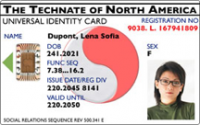 Scott further wrote,
 “The certificate will be issued directly to the individual. It is nontransferable and nonnegotiable; therefore, it cannot be stolen, lost, loaned, borrowed, or given away. It is noncumulative; therefore, it cannot be saved, and it does not accrue or bear interest. It need not be spent but loses its validity after a designated time period.”This may have seemed like science fiction in 1937, but today it is wholly achievable. In 2010 Technocracy, Inc. offers an updated idea of what such an Energy Distribution Card might look like. Their website states,
“It is now possible to use a plastic card similar to today’s credit card embedded with a microchip. This chip could contain all the information needed to create an energy distribution card as described in this booklet. Since the same information would be provided in whatever forms best suits the latest technology, however, the concept of an ‘Energy Distribution Card’ is what is explained here.”If you study the card above, you will also note that is serves as a universal identity card and contains a microchip. This reflects Technocracy’s philosophy that each person in society must be meticulously monitored and accounted for in order to track what they consume in terms of energy, and also what they contribute to the manufacturing process.
Carbon Market Players
The modern system of carbon credits was an invention of the Kyoto Protocol and started to gain momentum in 2002 with the establishment of the first domestic economy-wide trading scheme in the U.K. After becoming international law in 2005, the trading market is now predicted to reach $3 trillion by 2020 or earlier. Graciela Chichilnisky, director of the Columbia Consortium for Risk Management and a designer of the carbon credit text of the Kyoto Protocol, states that the carbon market “is therefore all about cash and trading – but it is also a way to a profitable and greener future.” (See Who Needs a Carbon Market?) Who are the “traders” that provide the open door to all this profit? Currently leading the pack are JPMorgan Chase, Goldman Sachs and Morgan Stanley. Bloomberg noted in Carbon Capitalists on December 4, 2009 that“The banks are preparing to do with carbon what they’ve done before: design and market derivatives contracts that will help client companies hedge their price risk over the long term. They’re also ready to sell carbon-related financial products to outside investors.”At JP Morgan, the woman who originally invented Credit Default Swaps, Blythe Masters, is now head of the department that will trade carbon credits for the bank. Considering the sheer force of global banking giants behind carbon trading, it’s no wonder analysts are already predicting that the carbon market will soon dwarf all other commodities trading.
Conclusion
Where there is smoke, there is fire. Where there is talk, there is action. If M. King Hubbert and other early architects of Technocracy were alive today, they would be very pleased to see the seeds of their ideas on energy allocation grow to bear fruit on such a large scale. In 1933, the technology didn’t exist to implement a system of Energy Certificates. However, with today’s ever-advancing computer technology, the entire world could easily be managed on a single computer. This article intended to show that- Carbon Currency is not a new idea, but has deep roots in Technocracy
- Carbon Currency has grown from a continental proposal to a global proposal
- It has been consistently discussed over a long period of time
- The participants include many prominent global leaders, banks and think-tanks
- The context of these discussions have been very consistent
- Today’s goals for implementing Carbon Currency are virtually identical to Technocracy’s original Energy Certificates goals.
Bibliography & Resources
Scott & Hubbert, Technocracy Study Course, Technocracy, Inc., 1934 Hanna, Toward a single carbon currency, New Scientist, 1995 Victor & House, A New Currency, Harvard International Review, Summer 2004 Hannah Fairfield, When Carbon Is Currency, New York Times, May 6, 2007 M. King Hubbert & The Technocracy Technate Design – Historical blog Everyone in Britain could be given a personal ‘carbon allowance’, Telegraph (UK) Network of European Technocrats – website for Europe Technocracy, Inc. – website for U.S. Technocracy Vancouver – website for Canada Association for the study of Peak Oil & Gas – website for Peak OilPlease add this page to your favorite Social Bookmarking websites... Patrick M. Wood is the editor of The August Review, which is an exclusive Internet-based publication and focuses on the Trilateral Commission, its members and activities. Patrick can be reached at: pwood@augustreview.com
View Comments
Guest Column——Bio and Archives
Items of notes and interest from the web.